

A WHILE BACK, I promised to reveal “Insider Secrets for Reading Great Literature,” things I have learned “the hard way,” which are not taught in schools or universities. I learned these things both as an ordinary reader of stories and as a student and teacher of literature; but I must admit that my understanding of stories has been sharpened by learning to write and edit stories. All of these have taught me some valuable practices that allow us to read a story for all it is worth, so, I think it’s high time I begin to fulfill that promise I made. I begin today with the most basic of precepts: read the whole story.
Excerpts Can Mislead Readers
It may seem self-evident that, in order to understand a story, one must read the entire thing, but the way we are taught great works of literature often flies in the face of such plain sense. No one would read a random chapter of a murder mystery or a thriller, for instance, and expect to come away with an understanding of the story as a whole, nor would anyone read the first three chapters of a murder mystery and expect to know whodunnit, much less why or how, or the significance of the murderous deed. Yet, how often do we treat the great literature in this careless and misleading fashion?
It always sets my teeth on edge to hear people refer to—or, worse yet, to teach—something they call “Dante’s Inferno.” Dante never wrote a work called “the Inferno”; he wrote The Divine Comedy, a complete story that happens to be composed of three successive parts, the first of which is called “Inferno,” (followed by “Purgatorio” and “Paradiso”). The poem’s true title, The Divine Comedy, alone should give us a clue what kind of story Dante intends to tell: a “comedy” is a story that ends happily for the protagonist. If you read the entire poem, you’ll know what that happy ending is; if you read only the first part, you will have no idea the story that Dante is trying to tell. To teach the first part of that story in isolation is, to my mind, a devilish act of literary destruction, intended to give an impression never intended by its author.
I was the unhappy victim of a similar sort of literary destruction as a high school student. I loved to read, and was eager to begin reading and understanding great literary works. By the time I began my senior English class, I was already familiar with Greek tragedy and found it fascinating, but I had yet to be introduced to epic poetry. So, I was excited to notice in the course syllabus that we would be introduced to the two great epics of Homer that semester. Even at the tender age of sixteen, I was aware that Homer’s work was considered to be among the greatest literature ever written. And yet, the snippets of The Iliad and The Odyssey with which we were presented gave a pretty poor impression. In fact, as I think back upon it, the passages seem to have been selected to titillate our imaginations rather than to give us any idea of the stories actually told in these two great epics. My impression of The Iliad was simply “men at war bashing each other, with gruesome results,” while the selections from The Odyssey—Odysseus’s fanciful accounts of his encounters with Polyphemus the Cyclops and with Circe, the witch who turned men into pigs—distorted that poem even more. I came away with the mistaken sense that The Odyssey was just a kind of highly-colored fantasy adventure, an impression that skewed my perception for twenty years—until I read the entire poem and discovered with a shock that it tells a completely different, and much more serious, story than those excerpts I read in high school had suggested.
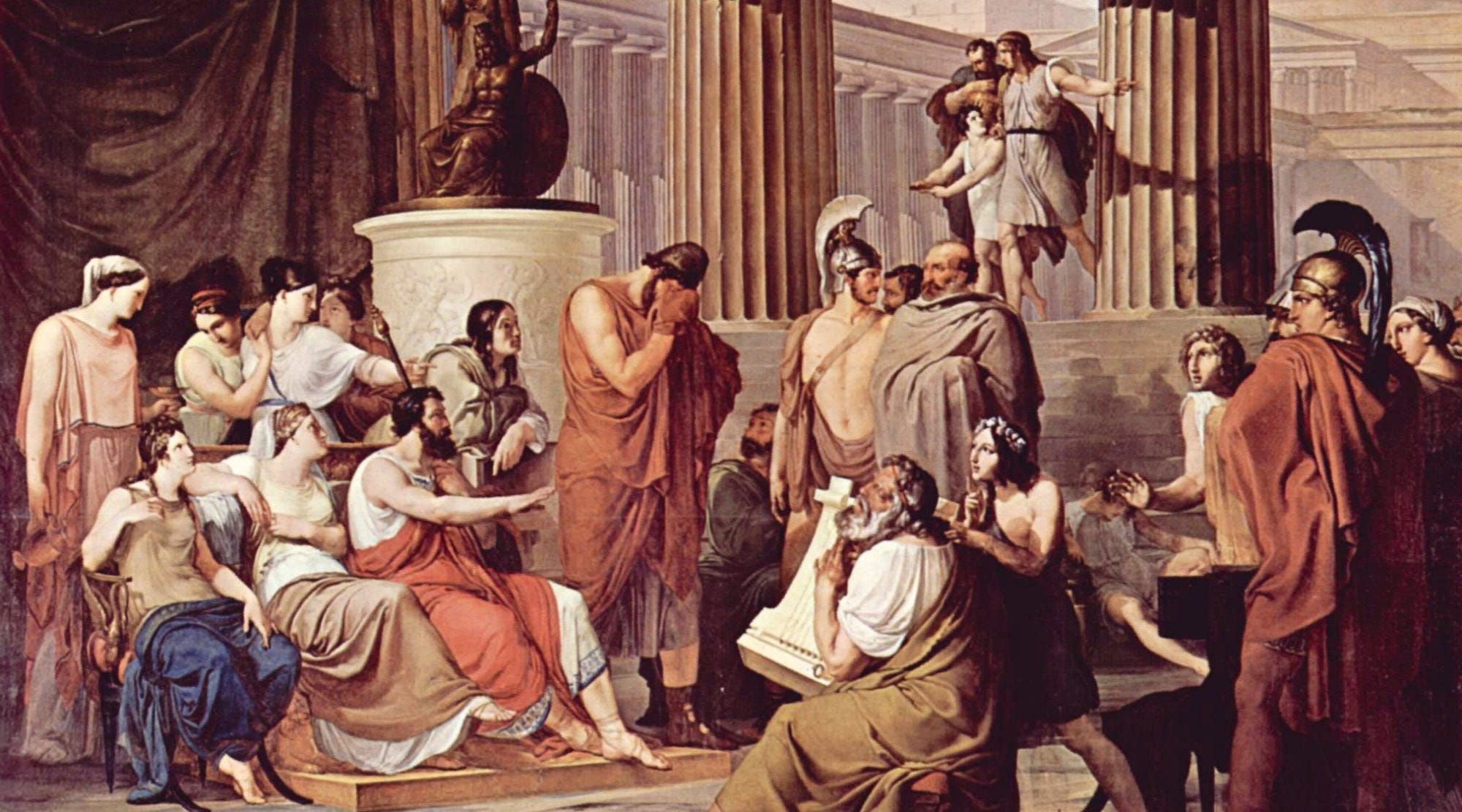
For one thing, I’d had no inkling that those episodes I’d read as a teenager were not part of Homer’s main narrative but rather were taken from one of several accounts of his travels that Odysseus provides over the course of the story. Each of these accounts is carefully tailored to appeal to the audience to which Odysseus is telling it and is designed to elicit the specific reaction he hopes for. The colorful and fantastical version I had tasted as a teenager is the version he tells to the Phaiakians who, until that moment, know him only as a shipwrecked refugee, a nobody who has washed up on their shores after a storm at sea. Sitting amongst a noble and courtly gathering, Odysseus unexpectedly regails them with an account of his travels designed elicit their admiration and to make them reassess him as a heroic figure.
After leaving Phaiakia, he will give other renditions of his story to other listeners, which are carefully fashioned to make him appear quite the opposite of heroic: a hapless (but sympathetic) victim of circumstances beyond his control. When I read those alternate accounts within the context of Homer’s story, I could see that each one has as its ultimate aim to garner sympathy from its particular audience, and in each case that listener is someone who, if sympathetically engaged, can help Odysseus in his cause to regain control of his long-neglected kingdom.
And that is the real story that Homer is telling in The Odyssey: the story of a man—husband, father, king—who returns home after a long absence and is faced with a mess to clean up, one that ensued during and because of his being away for so long. From this perspective, I could see how Odysseus’s boastful tales of toying with one-eyed giants and flirting with seductive witches fit into Homer’s overall plan for his story and why they were so misleading when taken out of that context. Recognizing the discrepancy between Odysseus’s fanciful account and the grim reality with which Homer was concerned not only increased my understanding of The Odyssey but also afforded me a glimpse of those qualities that have earned Homer his reputation as perhaps the greatest storyteller of all time.
As unimpressed as I was after my first brush with The Odyssey as a teenager, I now regard Homer’s story of Odysseus as a profound, complex story with a hero whose hardships prove to be the touchstone of his character. I could never have guessed such a transformation was possible, and it wouldn’t have been possible if I hadn’t read the entire story and, revisiting the poem time and again in my mind, come to see just how erroneous it was to think of it as a tale of giddy adventure. In fact, I would say that the poem itself, taken as a whole, argues against presenting hero tales as “mere fantastical adventures,” just as Dante’s Divine Comedy argues against the impression one gets by reading only the first portion, “Inferno.” But, to see that, one must read the entire story.
Understanding the Bible as a Whole
I find it sad that so many of the greatest literary works of the Western tradition known and judged only by carefully edited excerpts presented as “required reading” to students ill-equipped (and perhaps ill-inclined) to make sense of them. In too many cases, I fear, those students have experiences similar to my own—they come away from the experience thinking, “Is that all there is to it? What’s the big deal?” And, thinking that they now “know” what that story is all about, they move on with their lives and never revisit what they think they already know.
Infinitely more depressing is the thought that so many Catholics believe they “know” the Bible because they hear carefully excerpted and edited passages of it at Mass every Sunday. For many people, even those who assiduously sign up for every parish Scripture study, the idea that the Bible—that great library of Sacred Scripture—tells a single story will seem quite odd, even absurd.
The problem stems, I think, from two causes: first, regarding the Bible as simply a “library of books,” written by different people at different times, in different circumstances, and with different rhetorical aims, can be misleading. There is, of course, a great deal of truth in this description but there is also a great deal that it fails to recognize. Looked at this way, the canon of Sacred Scripture seems more like an anthology of vaguely related religious writings than as chapters in a single, unified story that unfolded over time. It’s a rare thing to find a Bible study that approaches Sacred Scripture as a unified, Divinely Authored story; most Bible study leaders find it easier to focus on one book at a time, but this often means studying them in isolation. And that, unfortunately, makes it much harder to see them in the context of the Bible as a whole.1
This brings us to the second problem: focusing on individual books often also means focusing on their individual human authors and the immediate historical and rhetorical considerations that governed its composition. This kind of focus tends to obscure the fact that every book in the Bible has the same Divine Author, who has a single Divine Plan that He is communicating, a single story that He is telling, from start to finish. Too often, Bible study (and even homilies based on the Scripture readings at Mass) focus on the human level of communication and ignore or exclude what God has to say in these divinely inspired writings. As a result, we tend not to think of the Bible as a single story, or perhaps even to regard God as its primary author.
And yet in its official teaching the Church affirms the unity of Sacred Scripture, time and again. For instance, Pope Benedict XVI, in Verbum Domini, a 2008 apostolic exhortation to the bishops of the Church, sums up the way Catholics make sense of the Bible, in continuity from the earliest, apostolic age of the Church:
On the one hand, the [Second Vatican] Council emphasizes the study of literary genres and historical context as basic elements for understanding the meaning intended by the sacred author. On the other hand, since Scripture must be interpreted in the same Spirit in which it was written, the Dogmatic Constitution [Dei Verbum] indicates three fundamental criteria for an appreciation of the divine dimension of the Bible: 1) the text must be interpreted with attention to the unity of the whole of Scripture; nowadays this is called canonical exegesis; 2) account is be taken of the living Tradition of the whole Church; and, finally, 3) respect must be shown for the analogy of faith. “Only where both methodological levels, the historical-critical and the theological, are respected, can one speak of a theological exegesis, an exegesis worthy of this book.”
(Verbum Domini 34; italics in the original, boldface adds my own emphasis)
A bit later in the same document, Pope Benedict emphasizes different aspects of the unity of Scripture: the unity of the levels of meaning (the literal, or what the human author intends, and the spiritual, which the Divine Author communicates) and the unity of the Old and the New Testaments. In other words, one cannot truly understand individual parts of the Bible without seeing them in the context of the unified whole and regarding them, as it were, from a “God’s eye view.” To neglect to do so obscures both the Divine Author and the spiritual meaning He communicates. If we try to understand “The Story that God Tells” in this way, the result will be as erroneous an understanding as was my impression of The Odyssey after reading only a couple of episodes taken out of context. But in the case of the Bible, the consequences will be much graver because it will mean misunderstanding God Himself.
Next time, I’ll look more closely at what a “whole story” looks like and how we can judge what a story is really about. Meanwhile, if you have ever read The Odyssey, you might try summarizing the story that the poem tells. Try the same exercise with the Bible, from Genesis through Revelation: if you try to think of the Bible as a unified story, what is the essence of that story? Can you summarize it in a sentence or two? I’d love it if you would share your summaries in the comments!
One excellent Bible study course that I can recommend does take pains to look at the Bible as a whole, while also regarding each book individually. It is offered as a free, self-paced video course by the Institute of Catholic Culture. The full course is comprised of two parts (Scripture 101 & 102, twenty lessons each for Old and New Testaments) and may be audited or, for those interested in garnering credentials, taken as a certificate course with required quizzes and final multiple-choice exam. The ICC also has a wealth of other courses and lectures related to the Bible—browse their site and explore!
The Bible course looks interesting. Thanks for the link.